
Best Time to Post on TikTok in 2026
Contents
- When is the best time to post on TikTok in 2026?
- Understanding the TikTok algorithm
- Know your audience
- Analyze your performance data
- Experiment and optimize
- Stay ahead of the competition
- Tools and resources
- More tips for success on TikTok
- Conclusion
Imagine yourself as the director of an epic film who has just finished their biggest blockbuster. You take a deep breath, hit the “post” button on TikTok and… silence. Where you expected hundreds of likes, comments and shares, there is only the digital echo of your own enthusiasm. How is that possible? The culprit is (drumroll, please) timing!
Packages for Influencers -> TikTok followers and likes, views of the highest quality for your profile!
Why is timing everything?
TikTok is like a secretive party. You can show up with the best gift in the world, but if you arrive at two in the morning, all the guests have already gone to sleep (or been snatched up by someone else). On the other hand, if you arrive at exactly the moment the party is just getting started, you instantly become the center of attention.
So if you release your freshly edited video at the ideal time, you have a chance of it becoming a viral treasure. And if not? TikTok will send it off on a little vacation into oblivion, where it will be showing other videos holiday photos and sadly reminiscing about what could have been.
When is the best time to post on TikTok in 2026?
You know how it is: it’s the middle of the week, most people have already recovered from the Monday shock and Friday is still far away. But between ten and eleven in the morning (Eastern Time), things start happening! This magical window offers:
- Start of the work / school day: Lots of people are just getting settled in at work or school and during the first breaks they reach for their phone like a drowning person grabbing a straw. Once they spot something interesting, they’re happy to engage – with a like, comment, or share.
- A short “wind-down” break: By around ten o’clock, most of us have already gotten through the first round of our morning routine, so we’re happy to steal a few minutes for a quick scroll. So if you release your new video right at that time, you have a great chance of grabbing attention.
How to make the most of this time?
- Prepare your content in advance: Whether it’s a short skit, tips & tricks, or a personal confession, have your video ready and scheduled so you’re not stressing at the last minute.
- Be quick and interactive: A short attention span calls for an intense opening. Use a catchy title, a fun punchline right at the start, or a surprising element that pulls the viewer in.
- Respond to comments: Your audience will appreciate it when you’re online and responding to their questions or reactions right after publishing. You’ll gain more loyal fans and boost the algorithm, which will happily reward you with better reach.
- Consider time zones: If you have a global audience, remember that not everyone lives in the EST zone. The timing may differ – but the morning “sweet spot” tends to be strong in many regions.
In short: whoever rules the morning, rules engagement. And if you don’t manage it? Don’t be discouraged – you can always try again the next day. Just don’t forget to have a coffee so you have enough energy for your next creative ride!
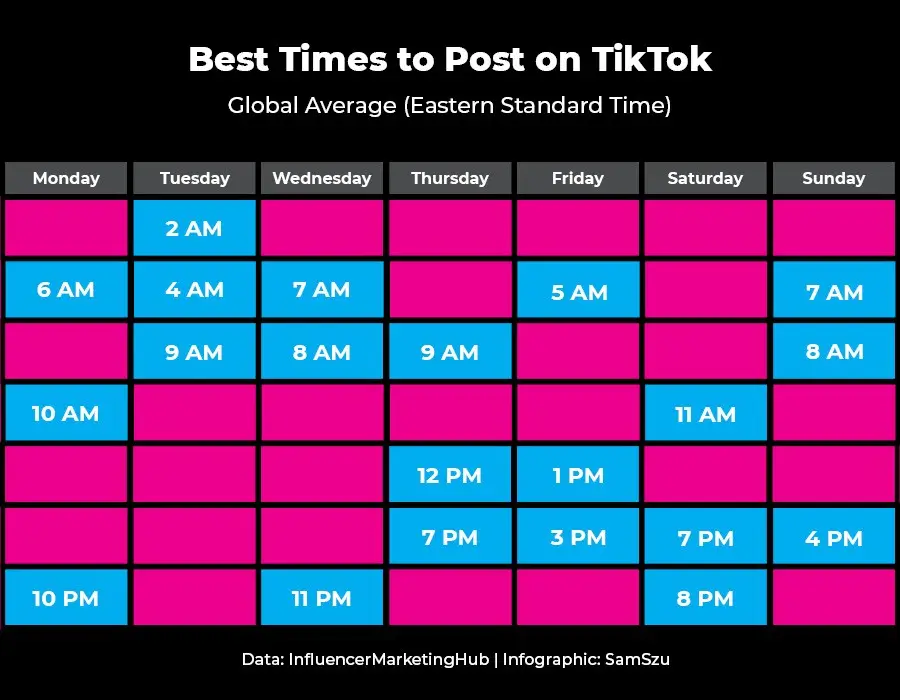
Best times day by day (EST)
| Day of the week | Optimal posting times |
| Monday | 6:00, 10:00, 22:00 |
| Tuesday | 2:00, 4:00, 9:00 |
| Wednesday | 7:00, 8:00, 23:00 |
| Thursday | 9:00, 12:00 (midnight), 19:00 |
| Friday | 5:00, 13:00, 15:00 |
| Saturday | 11:00, 19:00, 20:00 |
| Sunday | 7:00, 8:00, 16:00 |
Monday: 6:00, 10:00, 22:00
- Early risers: 6:00 AM is for the chosen early birds who need to know what’s happening in the world (and on TikTok) before their first cup of coffee.
- Lunch break (10:00 – 12:00): The reality is that a lot of people during their “lunch” break (which tends to stretch on) are more likely scrolling their phone than enjoying a salad.
- Before bed (22:00): At this time, some people are “smartly” putting off sleep and looking for an excuse on TikTok not to go to bed just yet.
TIPS:
- Be brief and snappy in the morning – people have sleepy attention spans.
- At noon, try to entertain; in the evening you can try a calmer pace or storytelling.
Tuesday: 2:00, 4:00, 9:00
- For a global audience: 2:00 and 4:00 AM? It sounds crazy, but if you have followers in other time zones, while you’re fast asleep, they’re running at full speed.
- Early morning routine (9:00): Some people start their day with coffee, others with endless scrolling. And as a creator, you can ride that wave nicely.
TIPS:
- Set up automatic publishing if you don’t feel like getting up at 2:00 AM every day.
- If you’re targeting Czech and European audiences, 2:00 AM and 4:00 AM may be unnecessary for you. But who knows, maybe dedicated “night owls” will appreciate original late-night content.
Wednesday: 7:00, 8:00, 23:00
- Commute time (7:00–8:00): Whether it’s students on the tram or office workers in their cars, the morning rush hour is the perfect opportunity to kill time watching videos.
- Late-night scrolling (23:00): When people open TikTok in the evening, they often don’t feel like going to sleep right away. Your video could be the last thing they see before they finally call it a night.
TIPS:
- Use catchy, short content in the morning: during rush hour, people have no patience for long monologues.
- Late-night videos can be more relaxed in nature (stories, casual chats), but also suspenseful – ideally the kind that viewers just have to watch to the end.
Thursday: 9:00, 12:00, 19:00
- Pre-weekend hype: Around nine and noon, many people are already thinking about how to survive the rest of the work week and looking forward to their days off – TikTok serves as a quick escape.
- Evening relaxation (19:00): The ideal time when people are slowly switching out of work mode and reaching for their phones to find something lighthearted.
TIPS:
- At noon, be punchy and funny (tap into that post-lunch energy with your audience too).
- In the evening, feel free to add a call-to-action – fans may have the time and mindset to consider your recommendations.
Friday: 5:00, 13:00, 15:00
- Casual Friday (5:00): Hear that alarm? Sure, you might be asleep, but there are those “crazy” people who are already working out, working, or hitting the road by five in the morning.
- Energy to kick off the weekend (13:00 and 15:00): Everyone is looking forward to their well-deserved time off, the atmosphere tends to be more relaxed, and people are checking social media more frequently.
TIPS:
- Take advantage of the relaxed Friday vibe – try a more fun format, music, or trending content.
- If you’re promoting a product or service, Friday can be a great moment to introduce a discount or a weekend teaser.
Saturday: 11:00, 19:00, 20:00
- Lazy morning (11:00): Waking up on the weekend is just different. People get up later and with a more relaxed pace (if they don’t have young children). Morning procrastination is in full swing.
- Prime evening activity (19:00, 20:00): When people are deciding whether to head out or stay home, they often browse TikTok as a form of “warm-up entertainment.”
TIPS:
- Use the weekend atmosphere to post slightly longer videos or storytelling content (if that’s your thing).
- On Saturday evening, try incorporating a poll or a question to get your audience actively involved (for example, whether they should have pizza or a burger).
Sunday: 7:00, 8:00, 16:00
- Morning relaxation (7:00–8:00): Some people are already up early, enjoying a quiet moment before family, friends, or any plans kick in.
- Sunday afternoon (16:00): People are mentally preparing for Monday, so they’re still looking for one last escape from reality.
TIPS:
- Sunday is great for inspirational or motivational content – people are reflecting on the past week while also gearing up for the new one.
- Challenge them to take action (e.g., “How are you preparing for the new week?”) to spark discussion in the comments.
Important Notes:
- Time zones matter: When choosing your posting time, take your target audience’s location into account. Adjust these times to when your audience is most active.
- Your audience is unique: Use TikTok analytics to get insights into the peak activity times of your specific followers.
- Consistency is key: Posting regularly keeps your content fresh in feeds and helps the algorithm understand when you are typically active.
- Content quality reigns supreme: Even if you post at the best times, your videos still need to be engaging, high-quality, and relevant to your audience in order to achieve success.
Understanding the TikTok Algorithm
The Basics
Think of the TikTok algorithm as a wise but somewhat secretive little goblin lurking in the corners of the app, deciding who gets to see your video and who doesn’t. Want to get on its good side? Here are the main things you should know:
1. The Algorithm Loves Engagement
Likes, comments, shares, watch time, and replays – all of these are like treats to the algorithm. The more you serve up, the more happily it wags its tail and pushes your content further and further. The result is a higher chance of landing on the coveted For You Page (FYP).
TIP:
- Try incorporating a call-to-action into your video (“Tell me in the comments what you think about…”) or an interesting question that makes users want to respond.
- Keep your watch time as high as possible. Shorter, snappy videos generally have a better chance of people watching them all the way to the end… and maybe even again.
2. Personalization Plays the Lead Role
TikTok remembers what you like, what you comment on, and what types of videos you watch all the way through. Based on that, it serves you content that should interest you. And the same goes for your viewers. If they enjoy videos about baking cakes, they probably won’t immediately see videos about motorcycles (unless it’s a cake shaped like a motorcycle).
TIP:
- Think about what type of audience you want to reach. Focus on creating videos that this group of users typically devours – and add your own “twist” (humor, personal stories, a unique style).
- Don’t underestimate hashtags and captions. They help TikTok better categorize your content and show it to the right people.
3. When to Post? It’s a Little Different for Everyone
It might seem like you’ve found the perfect time to publish, but the creator next door reaches peak viewership at a completely different time. Why? Because TikTok makes sure that everyone gets content tailored to them. The idea of one “magic” posting time is nice, but reality is a bit more complex.
TIP:
- Experiment! Try different times throughout the day and week and monitor how engagement changes.
- Use a TikTok Pro (Business) account, which offers analytics that will help you find out when your audience is most active.
2026 Algorithm Trends
Social media algorithms are a bit like an ever-changing dance routine. The basic steps stay the same, but new twists, jumps, and sometimes even backflips are regularly added. In 2026, interesting things are apparently going to happen, so if you want to stay in the spotlight at this dance party, keep reading.
1. Originality Above All
TikTok will (most likely) start placing even greater value on original content. Forget about massively repurposing videos from YouTube or Instagram – this platform craves fresh ideas and a unique approach.
Why does this matter?
When the TikTok algorithm recognizes that you’ve put your own invention into your video (such as a personal twist, a catchy comment, or an unconventional edit), it may reward you with better visibility. And that’s worth an extra minute of thought before you hit “share.”
TIP:
- Don’t rely solely on lip-syncing or repetitive trends. Try creating your own trend or hashtag that others can join in on.
- Don’t be afraid to experiment! Successful (and unsuccessful) videos will teach you more than weeks of theorizing.
2. Local Content in a Big Way
2026 is said to bring greater emphasis on local relevance. This means the algorithm will favor videos that fit into users’ cultural and temporal context a bit more. If you’re targeting viewers from a specific region, you’ll have a better chance of engaging them when you take their customs, holidays, and local topics into account.
Why does this matter?
Greater visibility of local content increases the need to time your videos smartly. If you ignore your audience’s real daily rhythm, you’ll receive fewer reactions – and the algorithm will be put off by you offering it inactive viewers.
TIP:
- Research the time zones and typical daily schedules of your target audience (students have breaks at different times than working people).
- Add elements to your videos that resonate with your audience – such as a mention of popular local foods, music events, or regional humor (but be careful to stay authentic).
3. The Faster You Post, the Further You’ll Go
The mantra of social networks used to be “longer and more engaging videos.” And while long, quality content is certainly not outdated, many experts say that shorter videos with a high watch-through rate may carry even more weight in 2026.
Why does this matter?
People’s attention spans are getting shorter and shorter (how many of us can watch a 10-minute video without skipping?). The algorithm will appreciate it when you can hook viewers with a lightning-fast punchline and keep them watching until the end – even if it’s just a few seconds.
TIP:
- If you can package your content into 15–30 seconds, do it. Every second counts.
- It’s still perfectly fine to have longer videos – just “break them up” into strong moments so viewers don’t lose interest.
Content Is Still King
You might nail the perfect time to post your video, but if your content is “about nothing,” TikTok won’t be carrying you on its shoulders. While the algorithm does care about good timing, it values creativity, value, and genuine audience interest even more.
- Tell stories (even in just a few seconds):
Sure, every second counts on TikTok, but even in this format you can weave in a distinctive story. Jump straight to the point and don’t forget to add a bit of suspense or humor. - Be authentic:
Viewers want to see real people. Forget artificially constructed scenes – be yourself and show a little behind the scenes. Mistakes and slip-ups can sometimes come across as human and endearing. - Hook them right from the start:
The first few seconds determine whether a viewer sticks around or scrolls away. Whether it’s a joke, a visual bang, or an unexpected sound, start sharp to grab their attention. - Add added value:
Whether it’s a tip, an interesting fact, or a simple recipe, pack your content with specific “aha” moments. People love learning something new (and TikTok loves it even more). - Simplicity wins:
You don’t need a super-professional studio and top-of-the-line effects. All it takes is a catchy idea, good lighting, and a fun execution. Feel free to film in your own kitchen if that’s more authentic.
Know Your Audience on TikTok

Imagine walking into a coffee shop without knowing whether your customers prefer a bitter espresso or a sweet latte with soy milk. You might give it a shot blindly, but the chances of hitting everyone’s taste are slim. It’s the same on TikTok – in order to find the best time to post, you first need to understand who is watching your videos (or who should be watching them).
1. Demographic Data
Age
- Generation Z (approx. 10–25 years old): These action-oriented “young rebels” often thrive on late-night mode and watch TikTok even during school breaks.
- Working professionals (25+): These users more often open TikTok in the morning before heading to work (a quick coffee and a little procrastination), during lunch, and late in the evening once they’ve finally cleared their work emails.
Gender
- Pay attention to whether your content topics align more with traditionally male or female audiences – or whether they appeal to everyone regardless.
- These days, the non-binary user community is also growing, and it’s worth keeping them in mind if you want a truly broad and inclusive audience.
Location
- There’s nothing quite like targeting residents of a specific city but posting your content at three in the morning. It might occasionally work (perhaps for the night shift), but most of the time it’s a wasted opportunity.
- In short, post when people are awake – and ideally when they have time to watch, not right when they’re running to catch a tram.
TIP: Try to at least roughly find out when your target audience’s workday or school day starts and when it typically ends. The closer you get to matching their daily rhythm, the better your chances that they won’t scroll right past you.
2. Time Zones
Putting together an amazing video and then publishing it when most of your followers are fast asleep is like shouting into the void (while pressing a super fancy megaphone that nobody can hear).
- EST (Eastern Time, USA): A huge portion of the TikTok community.
- PST (Pacific Time, USA): Suitable if you have a strong base on the West Coast.
- CST & MST: Don’t forget that the middle of America exists – and it’s quite sizable.
- International audience: If you’re targeting globally, prepare for an experiment: post videos at different times to cover various time zones. Sometimes it’ll feel like alchemy, but it’s worth it.
TIP:
- Take advantage of post scheduling and don’t be a slave to your alarm clock at ungodly hours.
- Track results using TikTok analytics and gradually fine-tune your schedule.
3. Interests and niche
It may sound obvious, but your topic has a huge impact on when and who will be watching you.
- Gaming content: Typically performs better in the evenings and at night, when players indulge in their hobby. Weekends are also gaming holidays.
- Foodie videos: Who doesn’t love watching delicious recipes over lunch? And what about before dinner, when the “what should I eat” dilemma reaches a critical level.
- Educational content: Students (and lifelong learners) tend to have time after school, during study breaks, or late at night when they should actually be studying.
- B2B & work-related: Weekdays and morning-to-midday hours work best, when people are casually scrolling on their phones.
TIP:
- Planning a pancake recipe video? Post it in the morning or late morning so people have time to go shopping for ingredients.
- Want to give advice on contract negotiation? Aim for the 9:00–17:00 window, when your audience is in work mode.
4. Audience analysis
The good news is that TikTok itself offers you a treasure trove of data about your followers. Simply switch to a TikTok Pro account (it’s free!) and you’ll gain access to Analytics.
- Dive into the data: Find out where your followers are from, their age and gender, and when they are most active.
- Track trends: If you discover that your audience is most active on Friday evenings, try to “double down” on that time slot even more. Save your best content for then.
TIP:
- Also review the various metrics: what percentage of people watch your video all the way to the end, at what moments they “drop off” the most, and so on. With this information, you can smartly adjust the length and structure of your videos.
Analyzing the performance data of your TikTok profile
You might squirm a little at the word “analytics” and picture endless tables full of numbers that seem more intent on frying your brain than helping you. But don’t worry – it’s precisely in these numerical waters that the key answers lie to the question: When and why do your videos actually take off? All you need to do is grab your diving gear (meaning a little focus) and dive into TikTok analytics.
1. A deep dive into TikTok analytics
The “Content” tab
If you haven’t yet explored the Analytics → Content section, now is the time to fix that. Here you’ll find out how each of your videos made its way into the world – and most importantly, how many people actually watched it or gave it a like.
Key metrics worth tracking:
- Total number of views: How many eyes (well, screens) have touched your creation?
- Likes, comments, shares: These are those little “confirmation” signals that your video was worth a reaction from people.
- Average watch time: Can viewers make it to the end, or do they turn it off after the first 2 seconds?
- Traffic source types: Find out whether your video is flying mainly on the For You Page, or whether people are searching for it directly on your profile.
Identifying peak times
Once you have an overview of the basic stats, try to dig for magical moments when your videos generate the most views and engagement. These could be days of the week, certain hours, or even specific time zones. You might discover that Tuesday evening is your personal prime time, while Friday morning is a total disaster.
TIP:
- Mark down the dates and times for all your more significant videos. Try jotting it down in a simple spreadsheet — when you posted what and how it performed. Patterns will soon start to emerge.
2. Competitor analysis: learn from the best (and the worst)
Of course, you don’t need to reinvent the wheel. Just take a look at your neighbors (or competitors) and see what days and times they post and what kind of reactions their videos are getting.
- Identifying similar accounts: Find 3–5 profiles doing something similar to you. Ideally ones that already have a solid community and regularly upload new content.
- Track their patterns: When do they usually post? Are their Mondays noticeably weaker, while Thursdays break records? Write it down, write it down.
- Adapt and experiment: Don’t copy their style to the letter (people want to see your uniqueness), but treat it as a valuable guide. It may turn out that your community responds differently, so feel free to test and fine-tune your own ideal schedule.
TIP:
- If you see that the competition is going full throttle on, say, Friday afternoon, try testing Wednesday or Thursday. You might just tap into a “hungry” audience waiting for something new.
3. Tracking results: diligence pays off
All this analysis would be worthless if you didn’t track your results regularly. Consistency is key — whether you go with an Excel spreadsheet, Google Sheets, or a sophisticated social media management tool.
- Simple spreadsheets: Record the date and time of publication, video topic, key metrics (views, likes, comments), and any notes (e.g., “used a funny filter for the first time”).
- Advanced analytics: TikTok Pro and other tools can also show you long-term trends, follower growth ratios over time, and other useful information.
TIP:
- Plan regular check-ins (e.g., once a week). Look at what worked best (or worst) and why. Then apply these insights to future videos.
- Pay attention to seasonal and holiday influences – for example, during Christmas, people’s behavior on the network can differ significantly from regular traffic.
Experiment and Optimize
Think of finding the best time to post on TikTok as an ongoing experiment. While data provides a solid foundation, the key lies in the unique preferences of your audience. Here’s how to use strategic testing to improve your timing:
A/B Testing
The essence of A/B testing on TikTok is posting similar content at different times to find out what works best for your audience. Here is a basic approach:
- Choose a metric: Decide whether you will primarily focus on views, likes, comments, or another engagement metric.
- Content consistency: Choose two comparable videos (similar topic, style, and length) to isolate the timing variable.
- Time variability: Post one video at your anticipated peak time and the other at a significantly different time slot.
- Analyze results: After a set period (e.g., 24–48 hours), carefully compare the performance of both videos. Did one significantly outperform the other in terms of your chosen metric?
Weekday vs. Weekend Patterns
Your audience’s online behavior can vary significantly between weekdays and weekends. Here are some questions you can explore through experimentation:
- Weekday consistency: Is there an optimal time that is consistently effective throughout the working week?
- Weekend variability: Do you notice a shift in peak engagement times on Saturday and Sunday compared to weekdays?
- Work vs. leisure: Consider how your type of content aligns with people’s mindset on weekdays versus weekends, which affects when they are most receptive.
Holiday and Event Scheduling
Major holidays, trending events, or viral challenges can significantly influence the best times to post on TikTok. Here’s how to adjust your strategy accordingly:
- Holiday awareness: Plan your content calendar around major holidays relevant to your niche. For example, your holiday-themed TikToks are best released a few days before the holiday, not on the day itself.
- Keep an eye on trends: Stay on top of TikTok trends. Can you creatively leverage viral challenges or popular events while still staying aligned with your brand?
- Time sensitivity: If your content relates to a specific event, make sure you post it within the relevant time window. A humorous TikTok about a trending awards show is best shared during or shortly after the event.
Consistency Is Key
Even the best-laid plans have little value without consistent execution. Here’s why consistency matters when optimizing your posting times:
- Algorithm Trust: Regularly publishing posts signals to the algorithm that you are an active and reliable content creator, which can influence your visibility.
- Audience Expectations: Audience Expectations: It builds a sense of anticipation and keeps your followers coming back for more posts.
- Reliable Data: Consistent posting over time provides more reliable data for analysis and informed decision-making.
Staying Ahead of the Curve on TikTok

Leveraging TikTok Trends
TikTok is a dynamic platform where trends emerge at a dizzying speed. Adapting to these trends gives you fantastic opportunities to boost your visibility and reach new audiences. Here’s how to do it effectively:
- Stay Observant: Pay attention to emerging trends — popular sounds, dance challenges, new effects, or formats that are gaining traction.
- Quick Adaptation: If a trend aligns with your brand and niche, act fast! Create your unique version of the trend while it’s still fresh and relevant.
- Authenticity is Key: Don’t force yourself into trends that feel unnatural for your brand. Audiences can sense inauthenticity, so focus on those that resonate with you.
- Trend Analysis: Even if you don’t jump on every trend, analyze the successful ones. Why did they resonate with viewers? Can you draw insights from them that can be applied to your regular content?
Adapting to Algorithm Changes
Social media algorithms are known for evolving. Stay informed about significant TikTok algorithm updates so your posting strategy remains effective. Here’s how to keep up:
- Reliable Sources: Follow reputable social media news blogs, industry publications, or creators who specialize in breaking down algorithm changes.
- Official TikTok Channels: Monitor TikTok’s blog or social media accounts for announcements or hints of potential changes in their focus.
- Analyze Your Own Data: Sudden drops or sharp spikes in engagement metrics can signal an algorithm change, prompting you to reconsider what works best.
Long-Term Strategies
Think of finding optimal posting times as a marathon, not a sprint. Use the following strategies to continuously refine your approach over the long term:
- Ongoing Data Analysis: Regularly review your TikTok analytics. Are you noticing changes in your audience’s behavior or the best times to post?
- Experiment Regularly: Don’t fall into the routine of only posting at the same time. Continue A/B testing and regularly try new time slots.
- Broader Social Media Context: Stay informed about broader social media trends and algorithm changes so you can anticipate how they may affect TikTok best practices.
Tools and Resources
TikTok Scheduling Tools
Scheduling TikToks in advance can be a lifesaver, ensuring consistency and allowing you to post during peak times even when you’re busy. Here’s a brief overview:
- TikTok’s Native Scheduler: TikTok offers a basic built-in scheduling feature accessible through the desktop interface.
- Third-Party Tools: Many robust social media management platforms (e.g., Hootsuite, Buffer, Later) offer TikTok scheduling features, often alongside advanced analytics and additional capabilities.
- Research and Comparison: When choosing a tool, consider features such as ease of use, supported analytics, and pricing.
Social Media Analytics Platforms
While TikTok’s built-in analytics are invaluable, specialized analytics platforms can uncover even deeper insights. Look for platforms that offer:
- TikTok-Specific Data: Dive into detailed metrics beyond what is available within TikTok.
- Competitor Tracking: Monitor the performance and posting habits of other creators in your niche.
- Trend Identification: Some platforms help uncover emerging trends across TikTok and other social channels.
Note: Before investing in paid tools, it’s best to start with TikTok’s native analytics and potentially try out other platforms for free. Make sure the additional insights justify the cost.
Calendars and Planners
Sometimes the best tools are the simplest ones. Consider these tools for organizing your TikTok strategy:
- Digital Calendars: Google Calendar or similar apps are great for planning content, setting posting reminders, and tracking key dates related to holidays or events.
- Physical Planners: If you prefer a tangible approach, use a dedicated planner to map out content topics, posting schedules, and track your insights over time.
Additional Tips for TikTok Success
Cross-Platform Promotion
Don’t forget to extend your TikTok reach! Strategically promote your most successful TikToks across other social media channels and on your website to broaden their visibility. Here’s how to do it:
- Embed TikToks on Your Website: If you have a website powered by Elementor, you can seamlessly embed your best TikToks to boost engagement and add a dynamic element to your site.
- Share on Instagram Reels/Stories: Repurpose your TikTok content for other platforms, especially those focused on short-form video, such as Instagram Reels.
- Teasers: Create short teasers of your TikToks for Twitter, Facebook, or other platforms that entice viewers to follow your TikTok and watch the full content.
Audience Interaction
TikTok thrives on community and engagement. Prioritize interacting with your audience to build loyalty and strengthen valuable algorithm signals. Here are a few ways to encourage interaction:
- Respond to Comments: Timely and thoughtful replies show your followers that you care and encourage further conversation.
- Duets and Stitches: Use these features to collaborate with other creators or creatively respond to existing TikToks in a seamless way.
- Q&A Sessions: Host live streams or dedicated Q&A posts to directly engage with your audience in real time.
Quality Over Quantity
Even with the best posting strategy, if your content doesn’t resonate with viewers, it won’t deliver the desired results. Always prioritize:
- Value: Does your video offer something truly entertaining, informative, or inspirational that will brighten viewers’ day?
- Creativity: Try unique angles, experiment with TikTok’s editing tools, and showcase your distinctive brand.
- Technical Quality: Strive for the best possible clean audio, well-lit videos, and smooth transitions.
Conclusion
Finding the best time to post on TikTok is an ongoing journey of data analysis, experimentation, and adaptation. Keep these key takeaways in mind:
- Understand the Algorithm: Understanding the basics of the TikTok algorithm will allow you to make strategic decisions about posting.
- Know Your Audience: Ideal posting times are directly related to the demographics, habits, and preferences of your target audience.
- Analyze and Adapt: Regularly dive into TikTok analytics, test different posting times, and be willing to adjust your strategy based on performance data.
- Stay Ahead: Keep track of algorithm updates, leverage trends, and maintain a long-term perspective for lasting success on TikTok.
Now it’s your turn! Implement these strategies, track your results using the tools mentioned, and share your insights with the community. Have you noticed an increase in engagement after optimizing your posting times? Are there any specific approaches that have worked exceptionally well in your niche?
Finding the perfect posting schedule never truly ends. Nevertheless, if you stay informed, keep experimenting, and prioritize quality content, you’ll be well on your way to achieving viral TikTok success in 2026 and beyond.
If you want results right away, you can get an Instagram followers and likes package right now.





Michal Záruba je specialista na digitální marketing a konzultant v oblasti sociálních médií a SEO. Více než 8 let pomáhá značkám růst online prostřednictvím strategického obsahu, optimalizace pro vyhledávače a efektivní komunikace na platformách jako LinkedIn, Instagram a YouTube.
Na svém blogu sdílí praktické tipy o tom, jak propojit SEO, sociální sítě a brand building do jedné funkční strategie. Zaměřuje se na to, jak firmy mohou využít moderní nástroje a algoritmy k tomu, aby jejich značka nezískala jen dosah, ale i důvěru.
Když zrovna netvoří obsah, přednáší o digitálním marketingu, školí týmy a sleduje nové trendy v AI a vyhledávání.